
Green hydrogen in Tunisia: investment debated in Sfax
On 21 November 2026, the Sfax section of the Order of Tunisian Engineers held a workshop on green hydrogen investment opportunities in Tunisia. Imed Derouiche, founder and president of H2GHUB, gave the keynote.

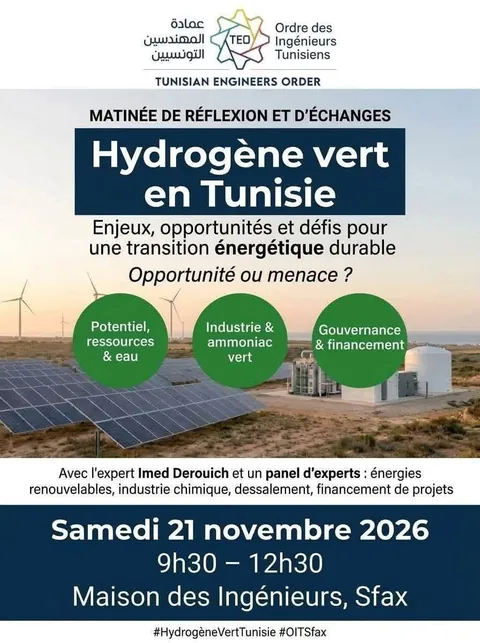
Engineers, researchers, investors and representatives of STEG and ETAP met on Saturday 21 November 2026 at Dar El Mohandess, the House of Engineers in Sfax, to discuss green hydrogen investment opportunities in Tunisia and the role of this energy carrier in the energy transition. Organised by the Sfax section of the Order of Tunisian Engineers, the workshop was built around a keynote by Imed Derouiche and an open debate, and ended with a set of recommendations.
Context
In their announcement, the organisers placed the meeting against the backdrop of growing green hydrogen investment in several countries of the region and of Tunisia’s participation in the SoutH2 Corridor, a project designed to link North Africa to Europe through a renewable hydrogen transport network.
The same text explained why the subject matters. Green hydrogen is seen as one of the promising ways to cut carbon emissions in heavy industry, transport and other activities that are hard to decarbonise with electricity alone. For Tunisia, the organisers wrote, developing the sector could help diversify the economy, attract foreign capital, create new industrial projects and jobs, and strengthen both energy security and the competitiveness of the national economy.
Programme and speakers
The poster announced a “morning of reflection and exchange” from 9:30 to 12:30, organised around three themes: potential, resources and water; industry and green ammonia; governance and financing. The organisers’ full title was “Green hydrogen investment opportunities in Tunisia and its role in supporting the energy transition”. The event is listed in the H2GHUB World Calendar.
- KeynoteImed Derouiche on the outlook for green hydrogen in Tunisia
- Remote talkSami Ben Rejeb, international energy expert
- Open debateQuestions from the floor, answered by Imed Derouiche and Mohsen Gharsi
International expert, founder and president of H2GHUB
Keynote
Sami Ben Rejeb
International energy expert
Remote talk
Mohsen Gharsi
Dean of the Order of Engineers
Debate
According to the announcement, the keynote was to address the prospects for a green hydrogen industry in Tunisia, the country’s place on the map of green hydrogen projects, and how its renewable resources, solar and wind in particular, could support projects able to attract investment and add local value.
The audience included experts, engineers, researchers and investors, as well as representatives of the electricity and gas utility STEG, the petroleum company ETAP, banks, financial institutions, public administrations and companies.
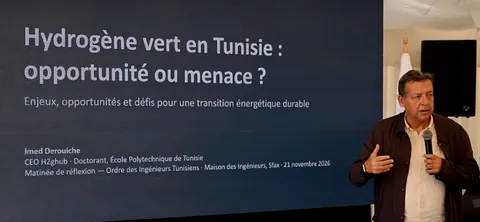
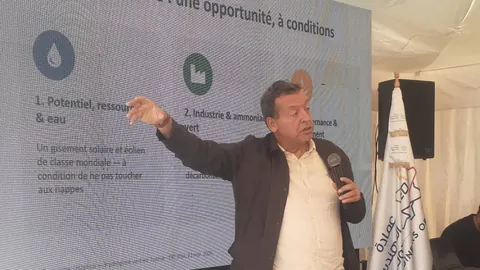 Video · FacebookDebate on green hydrogen investment opportunities in TunisiaView on Facebook (opens in a new tab)
Themes discussed
The report published after the workshop described a rich discussion that reflected differing points of view. The topics included:
- delays in launching projects, the legislative framework and administrative procedures;
- projects planned or possible in the north and the south of the country;
- uses in industry and agriculture, including the local production of ammonia and green fertilisers;
- water resources and production costs;
- financing and public-private partnership;
- energy and food security, jobs and local value added.
The announcement had also highlighted Tunisia’s solar and wind potential, possible uses in the chemical industry and in water desalination, and sectors that are difficult to electrify, such as heavy industry and transport.
The open discussion addressed the legal framework, administrative procedures, water resources, production costs, financing and public-private partnership.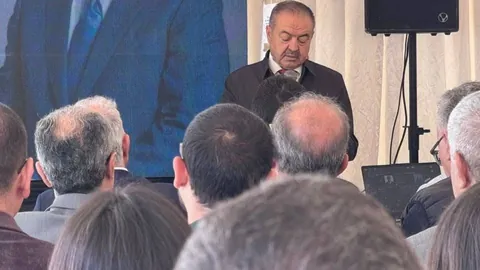 Video · FacebookMeeting on green hydrogen and the energy transitionView on Facebook (opens in a new tab)
Questions raised
According to the report, the debate raised the following questions:
- Why has Tunisia been slow to launch green hydrogen projects, despite its strategic location and its early start on the subject compared with several countries in the region?
- The national strategy and the memoranda of understanding signed with major international companies are still awaiting a legislative framework and administrative procedures that would turn these investments into concrete projects.
- Which projects are planned, or feasible, in the north and the south of the country?
- What role can hydrogen play in industry, in agriculture and in generating export revenue?
- How should water resources be used, and what is the role of the hydrogen corridor?
Key figures
- tonnes of hydrogen per year: the target of the national strategy for 2050
- 8 million
- memoranda of understanding with major international companies, awaiting a legislative framework and administrative procedures
- 8
Figures raised during the debate, according to the report published after the workshop.
Outcome of the debate
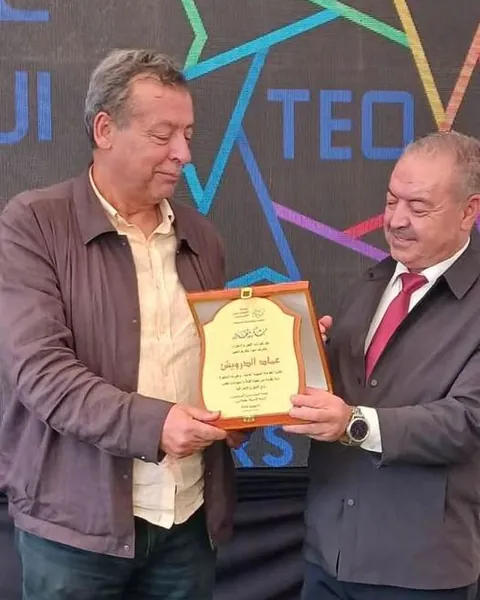
Imed Derouiche and Mohsen Gharsi answered the questions raised during the debate. According to the report, a set of recommendations and proposals was formulated to accelerate Tunisia’s engagement in green hydrogen investment. The contributions were recorded.
Further reading
 Photos · FacebookPhoto album of the workshopView on Facebook (opens in a new tab)
- Imed Derouiche on Facebook (opens in a new tab)Facebook page
- Order of Tunisian Engineers, Sfax section (opens in a new tab)Facebook page
Photos: © Imed Derouiche.